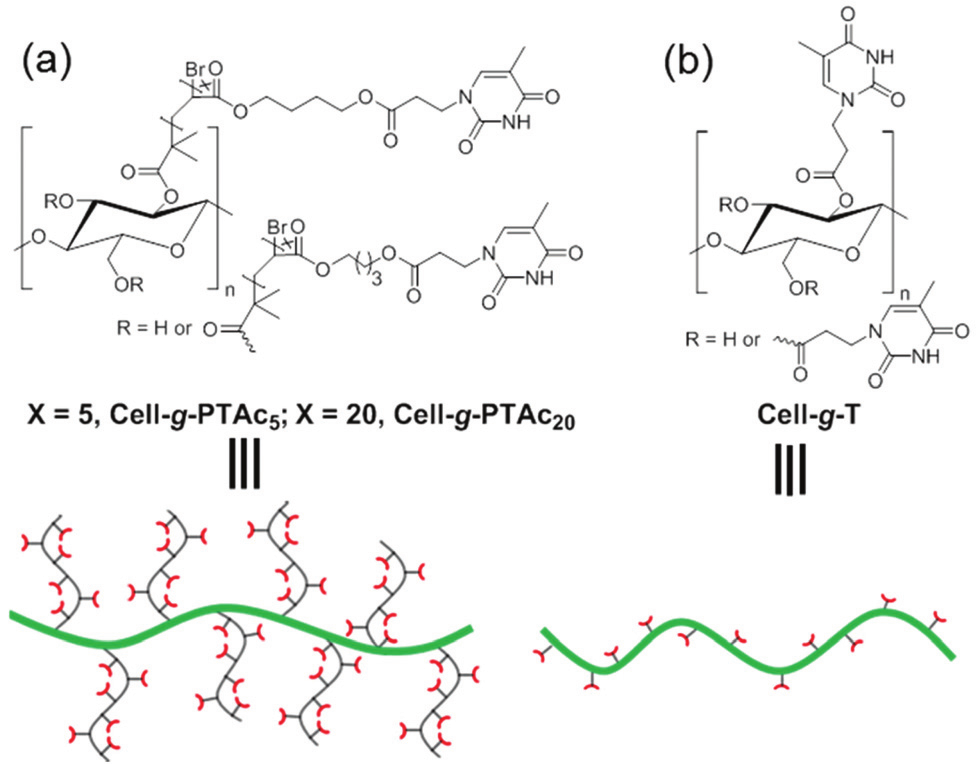
Renewable plant oil-based polymeric materials are promising to replace current petroleum-based poly-mers, considering their low cost and renewability. However, weak intermolecular interaction within the plant oil-based polymeric materials usually gives rise to poor mechanical properties. Herein, the mechani-cal properties of polymeric materials can be enhanced through dynamic supramolecular hydrogen-bonding (H-bonding) interaction by mixing thymine-modified-cellulose (Cell-T) or cellulose-grafted-poly(4-((3-(thymin-l-yl)propanoyl)oxy)butyl acrylate) (Cell-g-PTAc) with plant oil-based copolymers contain-ing complementary nucleobase moieties. The polymeric materials containing Cell-g-PTAc and plant oil-based copolymers with adenine have moderate mechanical properties due to the weak interaction between complementary nucleobases as elucidated by DSC and FT-IR analyses. Compared with bottle-brush copolymers Cell-g-PTAcs, the linear polymer Cell-T achieves a stronger and more efficient H-bonding interaction within the polymeric network (15.4 MPa over 1.8 MPa in tensile strength). Additionally, the rigid backbone of cellulose and residual cellulose hydroxyl group induced covalent crosslinking also play an important role in improving the mechanical properties, compared with the flexible backbone one with the same nucleobase. The strategy of utilizing the bioinspired H-bonding interaction between complementary nucleobases provides an efficient supramolecular method to fabri-cating strong plant oil-based polymeric materials.