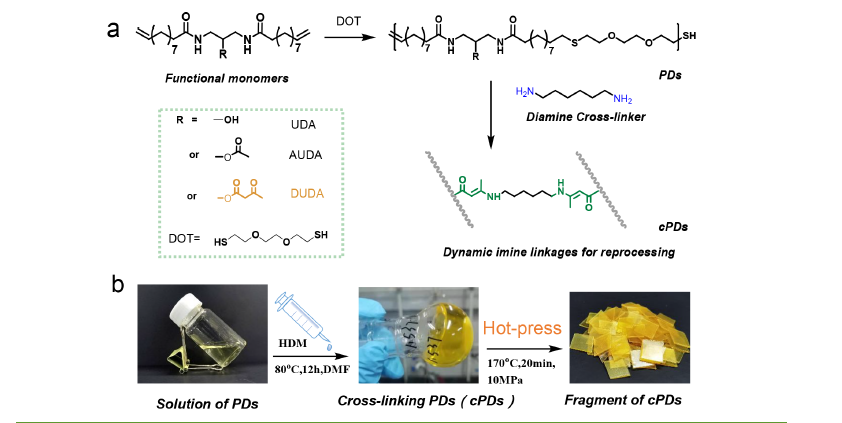
ABSTRACT: The integration of superb mechanical performance, good recyclability, and environmental friendliness is of key significance for the practical application of polyamide elastomers. However, the mutually exclusive conflicts among these properties make it challenging to balance them simultaneously. Herein, we describe a facile strategy to synthesize sustainable castor oil-derived polyamide elastomers with robust strength and good recyclability by means of dynamic vinylogous urethane chemistry. Distinctive acetoacetate−amine adducts with thermal-triggered dissociation and reassociation dynamics serve as chemical cross-linking units to provide cross-linking rigidity and reconstruction properties. Meanwhile, a amide hydrogen bonding array induced crystalline-tunable microstructure is employed to store entropic energy during dynamic behavior to achieve polymer system stability. Moreover, the amorphous phase forms stiff crystals when it is stretched through a transition that orders interchain hydrogen bonding, yielding a characteristic of excellent self-strengthening by mechanical training. Due to this property, the prepared polyamide elastomers exhibit high mechanical performance with a tensile strength of up to 156 MPa, an elastic recovery of 94%, and good recyclability with a tensile strength recovery of 95.6%, far superior to those of the reported polyamide elastomers.
KEYWORDS: Castor oil, Polyamide elastomers, Superb mechanical performance, Good recyclability