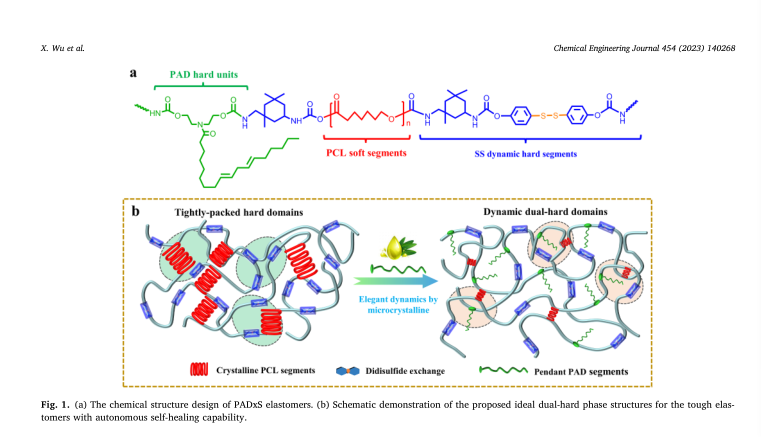
It is a key challenge to combine high mechanical strength and excellent autonomous self-healing properties in one elastomer to match the requirements of commercial applications. Chemical cross-linking or ordered crys-talline domains can afford high mechanical strength but are often based on the cost of losing autonomous self-healing performance. To address this dilemma, a strategy involving dual hard-phase structures was developed to reinforce self-healing polyurethane elastomers, by introducing plant oil-derived aliphatic chains into the hard segments. The dangling fatty acids not only allow segmental motion of the hard domains but also suppress the crystallization within polyurethane soft segments. The tailored dual-hard phase structure and dynamic chain motion are responsible for outstanding mechanical properties (tensile strength to 21.8 MPa and toughness of 131.6 MJ m−3) and autonomous self-healing ability (~100 % healing efficiency). Furthermore, a versatile me-chanical robust flexible conductor is conveniently constructed with an auto-repair capability at ambient con-ditions. This work represents a molecular design paradigm of simultaneously integrating balanced mechanical strength, durability, and self-healing ability for high-performance elastomers that can find applications such asskin-inspired wearable devices.