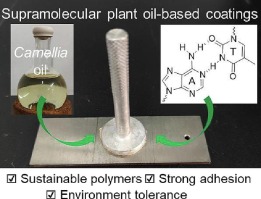
Plant
oils as the most typical and widest available biomass feedstocks have
been employed to construct organic coatings. In contrast to the
conventional plant oil-based thermoset
coatings, it is still challenging to fabricate robust supramolecular
plant oil-based coatings with reversible and dynamic noncovalent
interactions, overcoming the drawbacks of thermoset coatings. In this
work, we have reported a series of strong nucleobase-enhanced plant
oil-based coatings with multiple supramolecular interactions such as
hydrogen bonding, π-π stacking, hydrophobic and coordination
interactions. The nucleobase-functionalized supramolecular plant
oil-based coatings display strong adhesion and outstanding environmental
tolerance towards different pH conditions, the variation of
temperatures, and UV irradiation. In order to optimize the
polymerization of the plant oil-based monomer, the radical polymerization of methacrylate-type camellia
oil monomer (MCO) was studied to understand the influence of the
unsaturated carbon–carbon double bond in the appended long fatty chain
on the polymerization of the methacrylate. The stable propagation
radicals of methacrylate-type monomer result in the formation of
branched plant oil-based polymers with high efficacy. The copolymerization
of the plant oil-based and nucleobase-functionalized methacrylates and
the supramolecular mixing achieves the maximum adhesion of 9.89 MPa,
highlighting the potential of fabricating strong supramolecular plant
oil-based coatings.