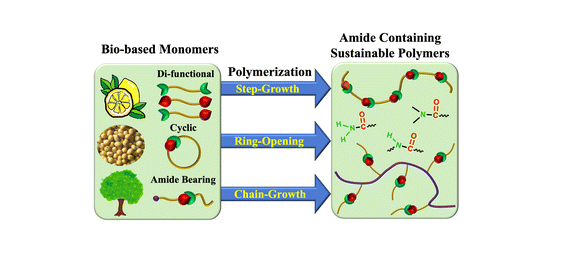
The field of sustainable polymers from renewable feedstocks is a
fast-reviving field after the decades-long domination of petroleum-based
polymers. Amide-containing polymers exhibit a wide range of properties
depending on the type of amide (primary, secondary, and tertiary), amide
density, and other molecular structural parameters (co-existing groups,
molecular weight, and topology). Engineering amide groups into
sustainable polymers via the “monomer approach” is an
industrially proven strategy, while bio-based monomers are of enormous
importance to bridge the gap between renewable sources and
amide-containing sustainable polymers (AmSPs). This feature article aims
at conceptualizing the monomer-design philosophy behind most of the
reported AmSPs and is organized by discussing di-functional monomers for
step-growth polymerization, cyclic monomers for ring-opening
polymerization and amide-containing monomers for chain-growth
polymerization. We also give a perspective on AmSPs with respect to
monomer design and performance enhancement.