Thermoset polymers from renewable resources are actively pursued via
thiol-related cross-linking chemistries. Most strategies lead to limited
interchain interactions and strong chemical linkages, and thus, the
networks exhibit inferior mechanical performance and are difficult to
recycle for further use. In this study, the reaction between thiol and
oxazoline groups exhibits a high selectivity to generate thiol ether
amide when catalyzed by 1,8-diazabicyclo(5.4.0)undec-7-ene (DBU).
Oxazoline-functionalized monomers are prepared from methyl vanillate and
cross-linked with polymercaptans via thiol-oxazoline ring-opening
addition reaction. The introduced amide groups significantly enhanced
the mechanical properties compared with those networks without amide
groups. Further, the amide-containing networks demonstrate improved
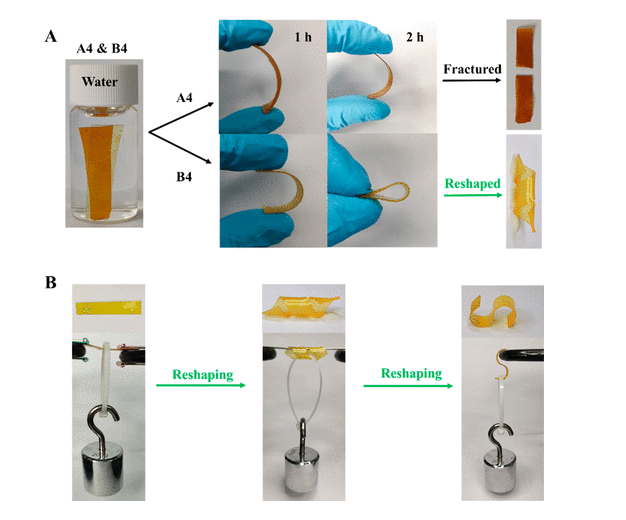
water-absorption capability, transforming the networks into hydroplastic
materials, while “hydration–drying” cycles minimally impacted their
physical properties. The selective thiol-oxazoline ring-opening addition
reaction herein imparts polar amide groups to thermosets, enabling an
efficient strategy toward enhanced chain interactions and recyclable use
through hydroplastic processing.